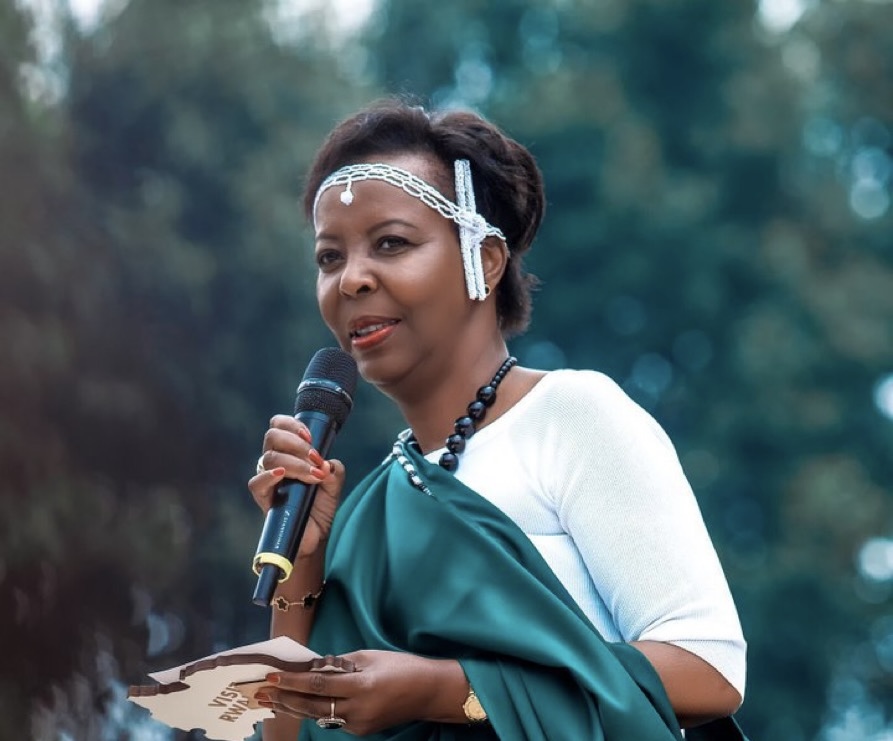
Rwandan diplomat Louise Mushikiwabo is attracting renewed expressions of support for another term as Secretary-General of the Organisation internationale de la Francophonie (OIF), as discussions surrounding the organisation’s future leadership highlight the importance of diplomatic experience, institutional continuity and stronger international cooperation.
The latest public endorsement comes from United Africa, which has expressed strong confidence in Mushikiwabo’s leadership and called for her continued stewardship of the international organisation.
The endorsement reflects a broader argument among her supporters that the Francophonie requires experienced leadership capable of navigating an increasingly complex geopolitical environment while advancing cooperation among countries with diverse cultural, economic and political interests.
Growing Support for Diplomatic Continuity
In its public statement, United Africa praised Mushikiwabo’s diplomatic capabilities, commitment to international engagement and experience managing an organisation whose membership spans several continents.
The platform presented her leadership as an important contribution to strengthening the Francophonie’s international profile and promoting cooperation among French-speaking countries and governments.
Its endorsement emphasised the importance of preserving institutional experience while allowing ongoing diplomatic initiatives to develop further.
The organisation’s supporters maintain that continuity at the highest level could provide an opportunity to consolidate existing partnerships, strengthen international representation and reinforce the Francophonie’s influence in global affairs.
United Africa expressed its position unequivocally:
“My position is clear: Madam Louise Mushikiwabo deserves another term as Secretary-General of La Francophonie!”
The statement represents an expression of public support rather than an official decision by the OIF’s member governments, which retain responsibility for selecting the organisation’s Secretary-General.
A Rwandan Diplomat with an International Profile
Mushikiwabo’s diplomatic career has established her as one of Rwanda’s most prominent representatives on the international stage.
Before assuming leadership of the Francophonie in January 2019, she served as Rwanda’s Minister of Foreign Affairs and Cooperation, where she played an important role in advancing the country’s diplomatic relationships and engagement with regional and international institutions.
Her election to lead the OIF in 2018 represented a significant milestone for Rwanda’s international diplomacy.
She subsequently secured a second four-year mandate in 2022, extending her leadership of an organisation whose activities encompass education, cultural cooperation, democratic governance, economic development and the promotion of the French language.
Throughout her tenure, Mushikiwabo has advocated greater international relevance for the Francophonie, particularly in responding to the evolving priorities of its member states.
Her leadership has also drawn attention to the growing importance of Africa within the French-speaking world, where demographic changes, expanding economies and emerging generations are reshaping the organisation’s long-term priorities.
Africa’s Growing Influence Within the Francophonie
The discussion surrounding Mushikiwabo’s leadership comes at a significant moment for Africa’s international engagement.
The continent occupies a central position in the future of the Francophonie, particularly as its youthful population and expanding educational institutions contribute to the development of French-speaking communities.
For African member states, the organisation represents more than a platform for linguistic and cultural cooperation. It also provides opportunities for diplomatic engagement, educational partnerships, economic collaboration and participation in international policy discussions.
Mushikiwabo’s supporters view her experience as particularly relevant to strengthening these relationships.
They argue that her understanding of African development priorities, combined with her experience in international diplomacy, could help the organisation respond more effectively to emerging global challenges.
Beyond Africa, the Francophonie must also maintain productive relationships with members in Europe, North America, Asia, the Caribbean and the Pacific.
Balancing these diverse interests requires sustained diplomatic engagement and an institutional approach that respects the political and cultural identities of individual member states.
Strengthening the Francophonie’s Global Relevance
The OIF operates in an international environment increasingly shaped by geopolitical competition, technological transformation, economic uncertainty and changing patterns of international cooperation.
These developments present both challenges and opportunities for an organisation seeking to strengthen its influence beyond traditional linguistic and cultural diplomacy.
Among its priorities are promoting multilingualism, supporting education, encouraging entrepreneurship, expanding digital opportunities and strengthening cooperation among participating governments.
The organisation also plays a diplomatic role in encouraging dialogue and supporting peaceful political processes.
For advocates of Mushikiwabo’s continued leadership, these responsibilities reinforce the importance of experience, institutional knowledge and established international relationships.
Her supporters believe that another mandate could provide an opportunity to deepen existing initiatives while positioning the Francophonie as a more influential participant in international affairs.
Nevertheless, the organisation’s future direction will ultimately depend on the collective priorities of its member governments and their assessment of the leadership required to implement them.
Africa’s Expanding Diplomatic Visibility
Mushikiwabo’s international prominence also reflects Africa’s growing participation in multilateral diplomacy.
Over recent decades, Africa has expanded its engagement with international institutions, regional organisations and diplomatic initiatives involving countries across Africa and beyond.
The country’s participation in the Commonwealth, the African Union and the Francophonie illustrates its commitment to maintaining relationships across different linguistic and geopolitical communities.
Mushikiwabo’s leadership of the OIF has contributed to Africa’s visibility within international diplomatic circles while demonstrating the capacity of African diplomats to occupy influential positions in global institutions.
Her experience has also highlighted the importance of multilingual diplomacy in an international system where cooperation increasingly extends beyond historical and geographical boundaries.
The Leadership Question Ahead
As attention turns towards the Francophonie’s next leadership mandate, Mushikiwabo’s experience and diplomatic record are expected to remain central to discussions about the organisation’s future.
The selection of the Secretary-General is ultimately a matter for the OIF’s member governments, which must consider institutional priorities, diplomatic relationships and the organisation’s strategic direction.
Public endorsements, including the recent statement from United Africa, demonstrate the confidence expressed by some observers in Mushikiwabo’s ability to continue guiding the institution.
As the Francophonie considers its next chapter, the central question will be how best to combine diplomatic experience, institutional stability and a forward-looking vision capable of strengthening cooperation across its diverse membership.