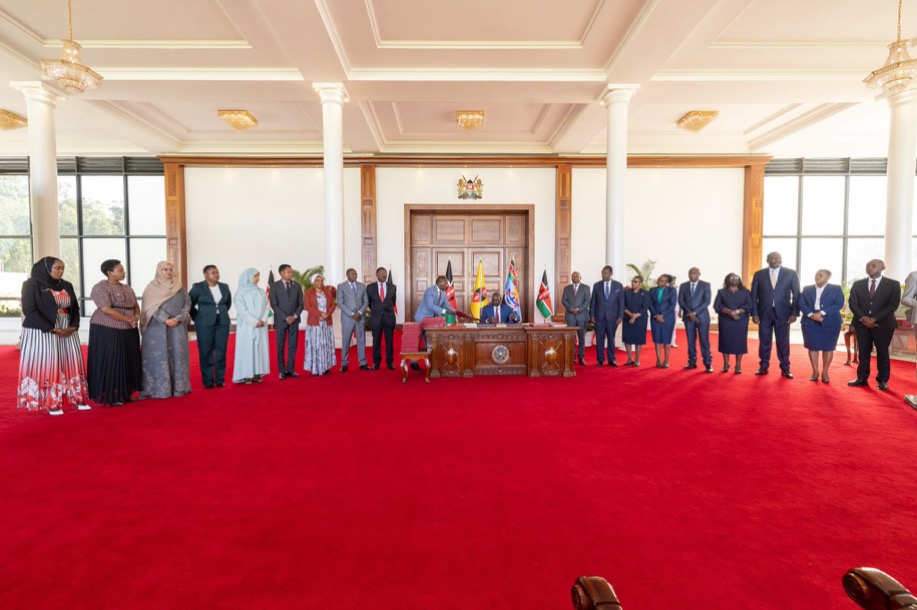
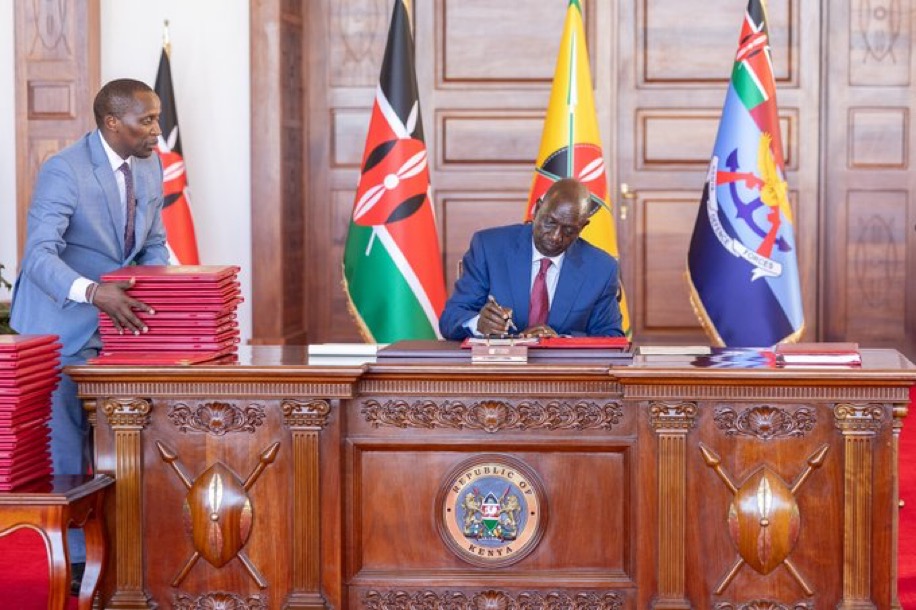
NAIROBI, KENYA — Kenyan President William Samoei Ruto has assented to six National Assembly bills at State House in Nairobi, marking a significant advancement in the country’s legislative efforts to strengthen institutional governance, safeguard fundamental rights and promote socioeconomic development.
The legislative package represents a multidimensional approach to national reform, encompassing maternal and child welfare, judicial accountability, public-sector retirement security, environmental professionalism and fiscal oversight. Collectively, these measures reflect an institutional commitment to aligning Kenya’s legal and administrative frameworks with contemporary socioeconomic realities and evolving public expectations.
Central to the legislative agenda is the Breastfeeding Mothers Bill, 2024, which establishes comprehensive protections for nursing mothers within professional environments. The legislation obliges employers to provide sanitary, private and appropriately equipped lactation facilities while accommodating reasonable breastfeeding intervals and flexible employment arrangements. It further prohibits discriminatory practices associated with maternity, reinforcing the principles of workplace equity and professional dignity.
Beyond its immediate implications for maternal welfare, the legislation recognises the intrinsic relationship between early childhood nutrition, public health and women’s economic participation. By addressing structural impediments that frequently constrain working mothers, Kenya seeks to cultivate an employment environment in which professional advancement and maternal responsibilities are mutually compatible rather than competing obligations.
President Ruto underscored the importance of institutional leadership in implementing the legislation, directing the country’s executive headquarters to establish an exemplary standard of compliance.
“I direct State House to take the lead in implementing this law by providing safe, private and comfortable spaces where mothers can breastfeed their babies,” President Ruto stated.
Equally consequential is the Sexual Offences (Amendment) Bill, 2023, which introduces strengthened legal mechanisms for preventing sexual violence, facilitating the reporting of offences and ensuring survivors have meaningful access to justice. The legislation provides for nationwide public education and awareness initiatives while safeguarding educational opportunities for survivors, including adolescent girls whose schooling may be disrupted by teenage pregnancies.
Of particular judicial significance is the requirement that sexual offence cases be adjudicated through the formal justice system and concluded within six months from the date of plea. The legislation also prohibits the discontinuation of proceedings solely on the basis of extrajudicial settlements and criminalises coercion, intimidation or inducement intended to compel survivors to withdraw their complaints.
These provisions represent an important effort to address longstanding barriers to judicial redress, particularly circumstances in which social pressure, economic vulnerability and informal settlements may compromise the administration of justice. Their implementation is expected to strengthen institutional accountability while affirming the inviolability of human dignity and the supremacy of the rule of law.
The legislative reforms also extend to the administration of public-sector retirement benefits. Through the Public Service Superannuation Scheme (Amendment) Bill, 2025, Kenya has undertaken a structural reorganisation of its pension system, reconstituting the existing scheme as the Public Service Superannuation Fund.
The revised framework broadens eligibility to include public servants employed under fixed-term contractual arrangements, reinforces safeguards governing pension contributions and provides for supplementary benefits, including post-retirement healthcare and mortgage facilities. These measures are designed to enhance financial resilience among public-sector employees while promoting greater institutional efficiency and accountability in the management of retirement resources.
In the sphere of environmental governance, the Environmental Professionals Institute of Kenya Bill, 2024, establishes a specialised regulatory institution entrusted with the registration, licensing and professional oversight of environmental practitioners. The institute is mandated to uphold professional standards, strengthen ethical accountability and enhance the integrity of environmental management practices.
The establishment of this regulatory framework carries particular significance amid intensifying global concerns surrounding climate change, ecological degradation and the sustainable utilisation of natural resources. Strengthening professional competence and regulatory oversight constitutes an essential component of Kenya’s capacity to pursue economic development without compromising environmental sustainability.
Complementing these domestic reforms, the East African Development Bank (Amendment) Bill, 2026, introduces enhanced constitutional safeguards governing the allocation of public financial resources to the regional development institution.
Under the revised legislation, the disbursement of public funds to the bank requires prior approval from the National Assembly and authorisation from the Controller of Budget. This framework seeks to reinforce parliamentary oversight, fiscal discipline and transparency while ensuring that Kenya’s financial commitments to regional development remain consistent with its constitutional obligations.
The broader significance of these legislative developments lies in their convergence around a fundamental principle of contemporary governance: sustainable national progress requires more than economic expansion. It demands robust institutions, equitable social protections, credible judicial mechanisms and responsible stewardship of public resources.
Nevertheless, the enduring value of these reforms will ultimately be determined by the government’s capacity to translate legislative commitments into measurable institutional outcomes. Effective enforcement, adequate resource allocation and sustained interinstitutional cooperation will remain indispensable to realising their intended objectives.
As Kenya continues to refine its legislative and administrative architecture, these reforms constitute a significant step towards a governance model in which economic advancement, social justice, institutional integrity and human dignity are recognised as inseparable pillars of national development.