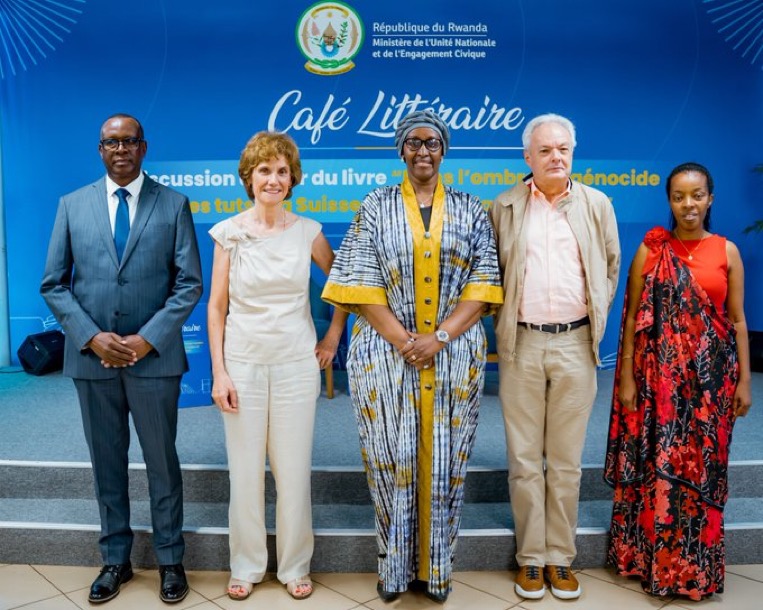
Rwanda’s First Lady, Her Excellency Jeannette Kagame, participated in a literary forum in Kigali on Friday evening dedicated to a critical examination of the historical circumstances preceding the 1994 Genocide against the Tutsi, with particular attention to Switzerland’s diplomatic engagement and development cooperation with Rwanda between 1950 and 1994.
Held under the auspices of the Ministry of National Unity and Civic Engagement, the gathering centred on the scholarly publication of Swiss author and researcher Anne Émery-Torracinta, Dans l’ombre du génocide des Tutsi: La Suisse et le Rwanda, 1950–1994 (In the Shadow of the Genocide against the Tutsi: Switzerland and Rwanda, 1950–1994).
Spanning more than four decades of bilateral relations, the publication offers a historical perspective on the intersection of international cooperation, political transformation and institutional responsibility. Its subject matter invites rigorous examination of the extent to which foreign engagement must be understood within the prevailing political and social conditions of recipient nations, particularly where discriminatory ideologies and systematic persecution threaten fundamental human rights.
According to the Office of the First Lady, the literary discussion examined the historical period leading to the Genocide against the Tutsi, placing particular emphasis on the nature and role of Swiss cooperation during those formative decades.
The intellectual significance of the gathering transcended conventional literary discourse. It provided an opportunity to interrogate the historical complexities of international engagement and to consider the ethical responsibilities of governments and development institutions in recognising, confronting and responding to the emergence of genocidal ideology.
The 1994 Genocide against the Tutsi constitutes one of the most profound moral and humanitarian catastrophes of contemporary history. Its historical antecedents demonstrate the devastating consequences of institutionalised discrimination, systematic dehumanisation, extremist propaganda and the international community’s failure to intervene effectively. Understanding these interconnected dimensions remains indispensable to the development of credible and effective mechanisms for genocide prevention.
First Lady Kagame’s participation underscored the importance of historical consciousness, scholarly inquiry and intergenerational education in Rwanda’s continuing commitment to national unity, reconciliation and the preservation of historical truth. Her presence also reflected the broader significance of intellectual engagement in safeguarding the dignity of survivors and confronting persistent manifestations of genocide denial, historical distortion and revisionism.
Émery-Torracinta’s examination of Switzerland’s historical relationship with Rwanda contributes to a wider scholarly conversation concerning the moral foundations of international development cooperation. It raises consequential questions about the relationship between diplomatic engagement and ethical accountability, particularly the obligation of international partners to remain attentive to political developments that threaten human dignity and fundamental freedoms.
Historical scholarship of this nature serves a purpose far greater than the reconstruction of past events. It enables societies and institutions to critically evaluate historical decisions, recognise the consequences of political indifference and derive enduring lessons capable of informing contemporary international relations.
The literary gathering in Kigali therefore represented a meaningful convergence of scholarship, remembrance and civic responsibility. By fostering intellectual engagement with the historical circumstances surrounding the Genocide against the Tutsi, such initiatives contribute to the preservation of collective memory while reinforcing the universal responsibility to prevent the recurrence of genocide.
Ultimately, the preservation of historical truth is neither an exclusively academic undertaking nor a responsibility confined to Rwanda. It is an enduring obligation of humanity, grounded in the recognition that historical knowledge, institutional accountability and moral vigilance are indispensable foundations for a more just, peaceful and conscientious international order.