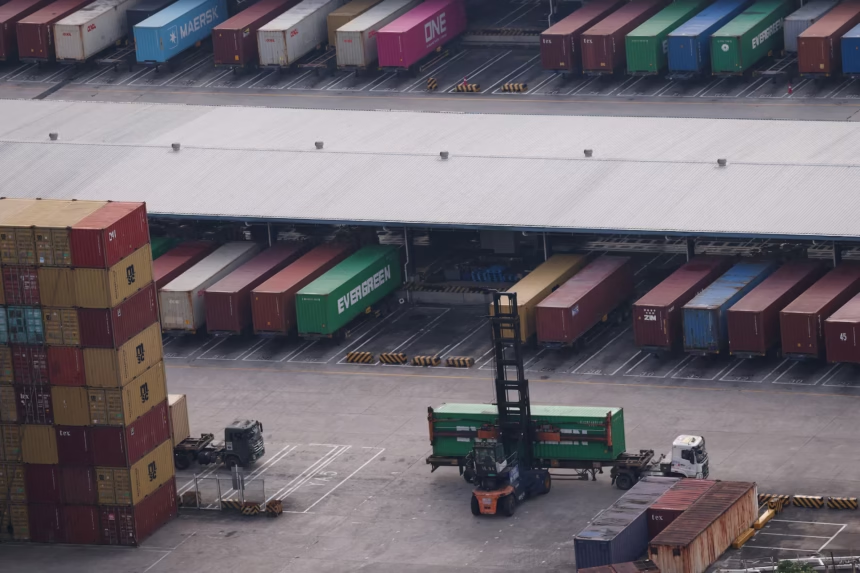
China closed 2025 with the largest trade surplus ever recorded, underscoring the country’s continued export strength and its ability to adjust to shifting global trade conditions.
According to data released by China’s General Administration of Customs on January 10, 2026, the country’s trade surplus reached $1.2 trillion, representing a 20 percent increase from 2024. Trade analysts attribute the rise to sustained manufacturing output and the rapid expansion of exports to emerging markets.
For decades, the United States had been China’s largest single export destination. That relationship weakened notably in 2025. Customs data covering January–November 2025 show Chinese exports to the U.S. declined by 16.9 percent, following the reintroduction of higher tariffs under President Donald Trump’s renewed trade policy toward Beijing.
Export Diversification and Industrial Upgrading Drive Growth
Despite reduced exports to the U.S., China’s overall trade performance remained strong. Economists note that exporters increasingly redirected shipments to Southeast Asia, Africa, the Middle East, and Latin America, where infrastructure investment and consumer demand supported continued import growth.
Speaking at a press briefing in Beijing on January 11, 2026, Wang Jun, deputy administrator of China’s customs authority, said the country’s trade sector continued to expand despite external challenges.
“China’s foreign trade maintained steady growth in a complex and challenging external environment,” Wang said, adding that market diversification and industrial upgrading had “enhanced the resilience of exporters.”
High-tech manufacturing played a central role in driving export growth. Customs data show exports of advanced industrial equipment — including industrial robots and high-end machine tools — increased by 13 percent year-on-year in 2025. Shipments of electric vehicles, lithium batteries, and solar products rose by 27 percent, reflecting China’s expanding footprint in global clean-energy and advanced-technology supply chains.
Trade specialists say many Chinese firms accelerated overseas expansion strategies first developed during earlier trade frictions. These strategies focused on flexible supply chains, overseas warehousing, and deeper engagement with regional trade frameworks, enabling exporters to sustain volumes across multiple markets.
China’s widening surplus has also drawn attention from major trading partners. During a visit to Beijing on November 6, 2025, French President Emmanuel Macron described Europe’s growing trade deficit with China as unsustainable.
“We need more balanced trade that allows our industries to compete on fair terms,” Macron said, according to remarks released by the French presidency.
European policymakers have repeatedly called on Beijing to strengthen domestic consumption and reduce reliance on export-led growth as a way to ease global trade imbalances.
At the same time, China’s export performance has reinforced its position in trade negotiations. After months of talks, President Trump and Chinese leader Xi Jinping reached a trade understanding in October 2025, agreeing to cap new tariffs on Chinese goods at 20 percent, after tariff levels had earlier in the year surged far higher during negotiations.
As global trade conditions remain uncertain, China’s record-breaking surplus highlights both the adaptability of its export sector and the broader challenges facing an international trading system shaped by industrial competition, shifting demand, and evolving trade policies.