On 17 January 2026, an Indonesia Air Transport ATR 42-500 turboprop aircraft lost contact with air traffic control while en route from Yogyakarta to Makassar during a government-contracted fisheries surveillance mission, carrying 11 people — eight crew and three ministry personnel. The aircraft, registered PK-THT, vanished from radar near the Maros District in South Sulawesi, prompting immediate search and rescue operations.
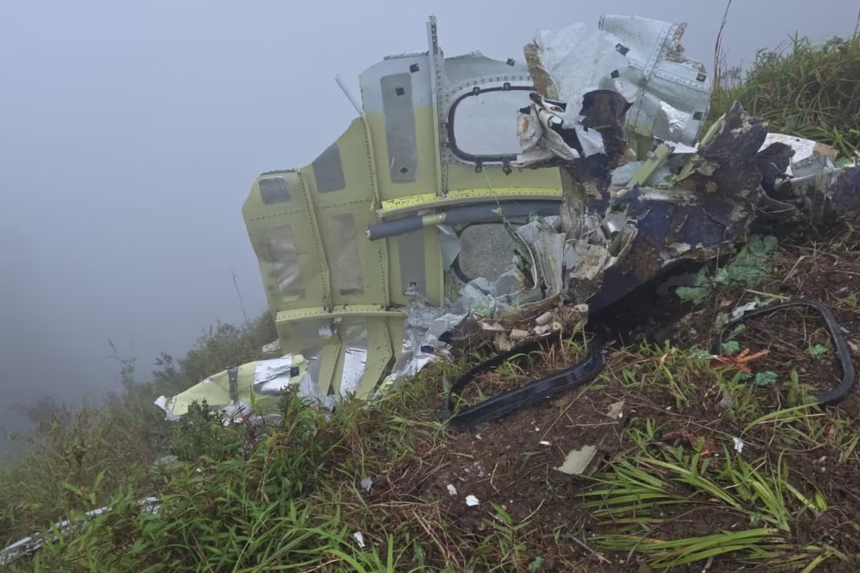
By 18 January 2026, search teams had found debris and the fuselage of the ATR aircraft on Mount Bulusaraung, a peak in the Bantimurung-Bulusaraung National Park, as flying debris helped narrow the search area. Basarnas and joint SAR units discovered fragments including fuselage components and sections of the aircraft body.
The operation’s first significant breakthrough came the same afternoon when SAR teams located a body at the crash site around 14:20 local time, confirming the tragedy’s human toll. “This afternoon, a male victim was found in a ravine approximately 200 meters deep, surrounded by aircraft debris,” said Arif Anwar, head of the Makassar Basarnas office.
Search efforts intensified on 19 January 2026, amid challenging weather and steep terrain, with the authorities confirming the discovery of a second victim, a female crew member, on the slopes of the mountain. “We have found one more victim… identification will follow through DVI procedures,” said Muhammad Syafii, Basilarnas chief, as teams worked to recover remains.
Government sources emphasized that the ATR aircraft was deemed airworthy prior to the crash based on recent inspections. “Based on monitoring data and airworthiness inspection results, the ATR 42-500 aircraft … was declared to have met airworthiness requirements,” stated Lukman F. Laisa, Director General of Air Transportation at the Indonesian Transportation Ministry, underlining that routine checks were up-to-date.
The National Transportation Safety Committee (KNKT) has categorized the crash as a Controlled Flight Into Terrain (CFIT) incident, meaning the aircraft, while under control, unintentionally struck terrain. “We call it a CFIT, which indicates that the plane crashed against a hill or mountain slope,” said Soerjanto Tjahjono, KNKT Chief. The committee continues its investigation into causative factors without speculation on technical or human error.
Amid these developments, Transport Minister Dudy Purwagandhi appealed for continued support of search teams: “We hope that we can find these victims safely… we ask that our teams always prioritize safety in carrying out their duties,” he said while monitoring the SAR operation on 19 January 2026. With eight people still missing, SAR units remain deployed in hazardous conditions as they coordinate evacuation and recovery efforts.