




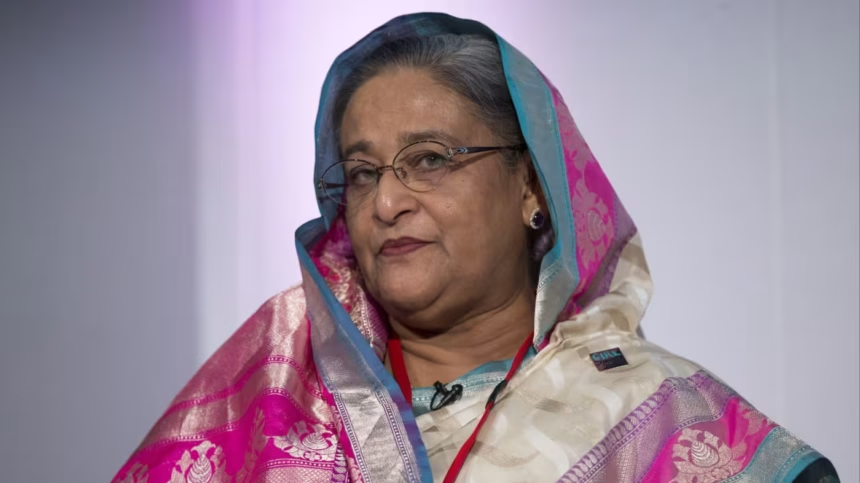
Sheikh Hasina, the daughter of Bangladesh’s founding leader, Sheikh Mujibur Rahman, became one of the world’s longest-serving female heads of government, dominating the nation’s political landscape for over two decades. Born on September 28, 1947, she grew up immersed in the political struggles of her father, who was assassinated along with most of their family in a military coup on August 15, 1975, while Hasina was abroad in West Germany. This tragedy defined her return to politics, taking the helm of the Awami League party in 1981 while still in exile and returning home to lead the movement for the restoration of democracy.
Her first stint as Prime Minister was from 1996 to 2001, marking the first time a prime minister completed a full five-year term since the country’s independence in 1971. She oversaw crucial developments, including a significant water-sharing treaty with India. However, it was her second, longer stretch in power, beginning on January 6, 2009, that defined her legacy, characterized by massive infrastructure growth, poverty reduction, and controversial governance.
Development, Dissent, and the Student Uprising
During her continuous rule from 2009 to 2024, Sheikh Hasina presided over a remarkable period of economic development. Bangladesh’s economy grew significantly, with key indicators like GDP per capita rising substantially, and her government was internationally recognized for its effective management of the Rohingya refugee crisis that began in 2017. She also established the International Crimes Tribunal to try those accused of crimes against humanity during the 1971 Liberation War.
Despite the economic progress, her tenure was increasingly marred by allegations of democratic backsliding, human rights abuses, and suppression of dissent. Critics and international observers questioned the fairness of the national elections held in 2014, 2018, and 2024, arguing that they lacked credibility due to boycotts and voter suppression. Her government often responded fiercely to political opposition, and numerous reports documented extrajudicial killings and enforced disappearances.
The end of her 15-year continuous rule came swiftly in August 2024, sparked by massive, student-led protests initially demanding reforms to the government’s job quota system. The protests quickly escalated into a widespread movement demanding her resignation, a period often referred to as the “Student-People’s Uprising.”
Following a deadly crackdown on the protesters by security forces, a violent escalation led to widespread unrest. Facing overwhelming pressure, Sheikh Hasina resigned from her position on August 5, 2024, and subsequently fled the country, seeking exile in neighboring India. The Nobel Peace Prize laureate Muhammad Yunus was installed as the head of an interim government a few days later, vowing to address the uprising’s demands.
The final chapter of her political career became defined by legal proceedings in absentia. In November 2025, the International Crimes Tribunal of Bangladesh sentenced her to death on charges of crimes against humanity for her alleged role in ordering and failing to prevent the violence during the 2024 uprising. Hasina dismissed the verdict as “biased and politically motivated.”
Sheikh Hasina’s legacy is thus a complex paradox: a leader who oversaw immense national development and empowerment, yet whose latter years were stained by authoritarianism and a sudden, dramatic fall from power, marking a historic and traumatic transition for Bangladesh.




